Saturday, February 12, 2011

Aelan Recipes

Good Afternoon,

My life here is so bafflingly different that I'm not sure how to even begin describing it. That's why I've been posting pictures instead of telling stories. I'm still not sure what to do so I'll start with something simple. Here's what I eat. The following recipes for "aelan kakai" can be easily prepared in your home if you'd like a little taste of the islands.

First, a word on ingredients. The people of Epi, and I think much of Vanuatu, use coconut milk like classic French cooking uses butter. To obtain coconut milk, find a dry coconut. The brown, furry, pre-husked coconuts you can find at the grocery store are dry coconuts. Hold the coconut in your hand on it's side so that the little face holes of the shell are at your thumb. Whack the coconut with your machete until it cracks open. It takes some practice to get it to open into two half spheres with clean edges. Next, scratch out the insides of the coconut. We use a "rass-rass" to make coconut shavings like those you would find dried in a bag in the baking section of your supermarket. Most recipes need two or three coconuts, scratched out. If you've managed to save the coconut water after opening, add that to the bowl of shavings. You can use a little water instead if you've made a mess of things. Squeeze the shavings with the water to get them to soak it up. Then, take handfuls of wet coconut shavings and squeeze them over your food. The white coconut milk will come out.

Alternately, I suppose you could buy the stuff in a can at the grocery store, but what's the fun in that?

Secondly, aelan cabis (island cabbage) is a broad leafed vegetable that resembles big green maple leaves growing on bushes. It's like a really strong spinach that retains it's shape a little better when boiled.

Basic Epi Breakfast
This is what we commonly eat in the morning if their aren't leftovers.
Boil a pot full of bananas in the skin. You can use strong bananas that have the consistency of plantains, taste like potatoes, and look like really fat bananas. You can use small sweet bananas the length of your finger. There are "Chinese bananas" that I think are the Cavendish bananas we have in the states. Then, there's a few others that all look the same.

After boiling the bananas, skin them and serve. If you'd like, milk some coconuts and poor the milk onto the peeled, cooked bananas, or boil the milk a bit and it will thicken.

Do this everyday for a few weeks.

Basic Epi Supper
Skin a pile of manioc (cassava), kumala (sweet potato), taro, or yams (sorry, I've never seem them in the states and no, that can of "yams" you ate at Thanksgiving was actually sweet potatoes).

Chop the skinned root crops into giant pieces and boil them. Don't use too much water, just enough to cook them or you're just wasting firewood. Just before serving, milk a few coconuts into the sauce pan with the root crops and serve.

If you have it, throw some aelan cabis in there and boil it too. Feel free to mix and match root crops at will or eat the same one everyday for a week.

Do this every night for a few weeks.

Bush Lunch
If you've gone to the garden with the family, why walk the hour or two back to the village fro lunch when you're surrounded by food. Dig up some wild yams, find some strong bananas, or knock down some breadfruit. Build a fire. Through the unskinned food onto the coals and roast them. Remove the burnt skins with your bush knife or scratch it off with a piece of broken glass. Wrap the food in a banana leaf so you don't burn your hands and eat. Get your little sister to climb a coconut tree and knock down some green coconuts to drink.

Simporo
So, you've got some time and energy and you don't want boiled food? Make Simporo. Skin a root crop or strong bananas. I prefer yams. Use a wooden board with a length of nail-perforated metal on it to scratch out the food into a mush. Place a de-stemmed aelan cabis leaf on one hand and use the other to grab a half handful of the mush. Put it in the middle of the leaf and roll it like a mini-burrito. Store the stuffed leaf cigar in a sauce pan and just keep stacking them in there until you've made thirty or so. Put an inch or two of water in the pan and steam the whole thing over a fire.

Lap-Lap
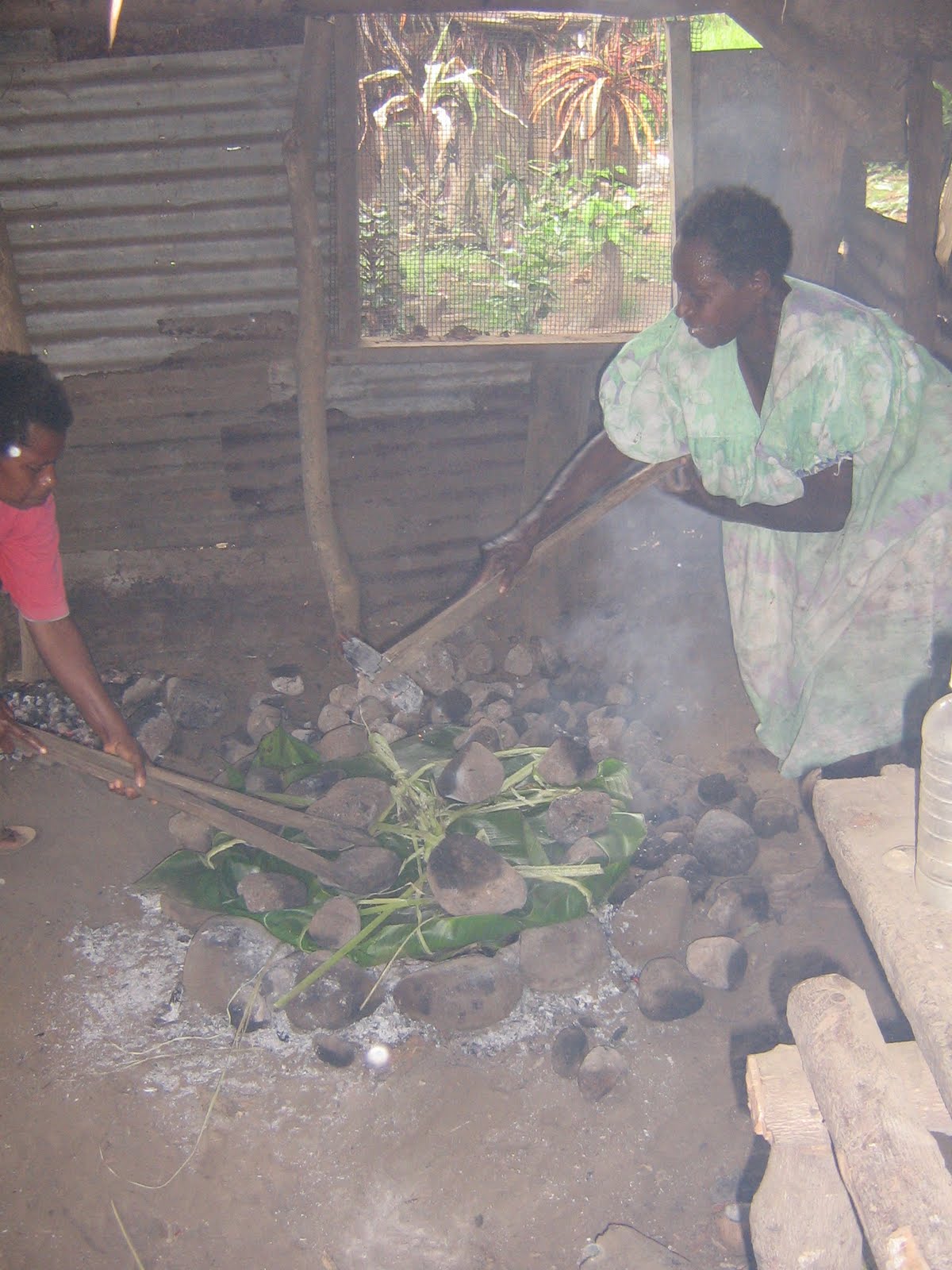
If there's a wedding, if it's Saturday, if there's a celebration of any kind, then there must be lap-lap. Dig a shallow pit, fill it with black stones and make a bonfire on top of them. While the fire is burning, scratch out buckets of bananas, manioc, or yams. This will take a long time if your feeding a horde of villagers. When the fire has burned out, sweep out the ashes with a tree branch covered in green leaves that you just cut down. Using split poles as giant tongs, remove half of the hot stones from the pit. Cover the remaining stones with lap-lap leaves. Lap-lap leaves are like banana leaves but bigger, stronger, and largely impervious to fire. It's like baking with oiled parchment paper. Poor the mush you're made onto the lap-lap leaves making a big disk like an inch thick wagon wheel. If you've got aelan cabis, put a layer on top of the mush. Wrap the leaves on the edges around the disk and put a few more on top. Put the hot stones you removed on top of the whole mess and leave the lap-lap to cook for a few hours or over night. After, remove the stones, unwrap the cooked disk, cut, and serve. If you've made banana lap-lap, you may notice that your local Peace Corps volunteer is suddenly absent eating with the neighbors. If you used manioc, he will suddenly be very friendly and hang around your kitchen.

Bread Fruit lap-lap
It's not really lap-lap, but I don't know what to call it. Pick some breadfruit that are ripe, but not mushy yet and roast them over hot coals. Remove and skin the breadfruit. Cover the palms of your hands in coconut milk (it can do anything) so that they won't burn, grab a skinned breadfruit in one hand and beat the hell out of with a stick held in the other. Turn the breadfruit while doing so and remove any exposed seeds or the core and you mercilessly pound this innocent vegetable. After pulping it into something like bread dough, give it to your grandma who will add it to the pile and spread the smashed stuff out on a big wooden tray. Milk a coconut over the weird breadfruit pizza dough you just made. Cut and serve.

Pumpkin Rice
There are pumpkins about, but the only acceptable ways to serve them are to chop and boil them like root crops or to chop and boil pieces of pumpkin with rice. Then mash the pumpkin about so you have orange rice. Kids love it. Do not attempt to make pumpkin soup or pumpkin pie no matter how delicious as the children will simply stare at it and wonder why you would waste a pumpkin like that and can they just eat more manioc with coconut milk, please?

Lemon Leaf "Tea"
Boil a very large kettle of water. Add the boiling water to mugs and add four to five tablespoons of white sugar per mug. If you have a Peace Corps volunteer present, remember that he likes his tea, unsweetened so only add two or three giant tablespoons of sugar per cup of water.

Oh, sometimes you can add a handful of lemon leaves to the boiling water, but this step is largely unnecessary.

------

I'm surprised, but that's about it. There's wedding day beef soup, but the above list is 90% of what we eat on Epi. Chop up whatever fruit is in season and serve on the side. The occasional fish or snake bean can be tossed in the boiling water when you make root crops, but that's about it. There you have it, my diet on Epi. It's obscenely healthy, I get just enough protein, though very little meat, and I get my vitamins from the aelan cabis and fruit. The strangest part is that I like it. In fact, I'm going to cook some snake beans tonight that I purchased from some mamas on the side of the road. After a long day of traveling to talk about business or working in the bush, I look forward to eating roasted wild yams.


Daniel

E-mail and Videos

Good Afternoon,

Vanuatu is weird and wild and wonderful and I don't know where to begin. First, some administrative details. I can be reached through the Peace Corps address I'm mentioned before, but letters can be sent to me directly on Epi. I'm not supposed to put my address in this blog, but ask around and someone will have it. If you'd like to save on postage and cut out a week or two of mail delivery time, however, you can send an e-mail message to volunteer@vu.peacecorps.gov with my name and island in the subject line. The person who checks that in-box will print out the letter and include it with my other mail. Please send me a letter, but be sure to include a return address so I can write back.

I will be in Port Vila until Saturday, February 19 and internet access will be spotty at best. After the 19th, it's back to Epi where there I have no internet, no electricity, and slow moving mail. If you have a question or just want to chat, now's the time. If you're trying to call me, however, know that my mobile phone was lost in the salt water when Jared and I capsized the canoe near Laman Bay, but that's a whole different story. I'll have a new Digicel phone soon and I think the same number.

It is likely that I will be in Port Vila for a week or two again before the end of the year, probably in late August. Just like now, though, I'll spend most of my time either attending to things at headquarters or running around Vila trying to take care of business before going back. Sorry I haven't been more communicative on the log, but I'm going to try to remedy that this week.

Wikipedia has an article on Epi: http://en.wikipedia.org/wiki/Epi_(island)
John Karp pointed me to some videos of the island. The first is a video of landing at the Laman Bay airstrip: http://video.google.com.au/videoplay?docid=-9019154185975805492# If you haven't landed in a small prop plane on a muddy patch of grass snuggled between the ocean and a forbidding wall of coconut trees, then you haven't known the terror of landing on Epi. Fortunately the airport agent is good at keeping the wire fence mended to that cattle don't wander onto the runway.

The second video is a compilation someone made of scenes of Epi. It's not mine, but it will show you where I live. http://www.youtube.com/watch?v=Tai0sOAnQEM

The music you here at the beginning is some of the ubiquitous string band music beloved of everyone else in Vanuatu. I'd like it too if I didn't have to hear the same dozen songs over and over again. The Chinese family that lives across the alley from my motel room was playing some classical Chinese music last night and it was such a relief to here something different.

The video starts with a landing at Laman Bay airport followed by a little tour of Laman Bay. Yes, they water in the bay is that blue. Sometimes, people catch tuna out there.
There's a picture of an outrigger canoe that looks just like mine at about the 1:10 mark.
At 2:06 you can see what the road looks like on a good day. Now, during the rainy season, there are big holes in it.
At 2:24 you can see one of the many nakamals dotting the island. Most villages have one.
At 2:38 there's an expanse of wide beach leading to a piece of landing jutting out. I think that's the same beach I trekked across with Marco, Robinson, and Michael in order to catch a boat to Ngala during out November business trip.
At 3:00 you can see some of the coral I see when I go fishing in the canoe. This video doesn't give a good idea of how colorful the coral can be.
At 4:15 notice how close the houses in the village are. Most of the villages seem that way because we're all hemmed in by the steep hills.

The last video is a tourism promotion video from Shefa province. This is a "cleaner" view of Epi, but it's close enough to real life: http://www.youtube.com/watch?v=cj8chB9ryVo. I don't live in a situation that is at all similar to the tourist bungalow depicted nor do I eat food that looks like that. The view is the same.

I'll try to post more pictures soon.


Daniel


Friday, February 11, 2011

Photos from Epi Part 2


Good Morning,

It's Saturday morning in Port Villa and although I have long list of little tasks and chores to take care of before going back to Epi, I want to take advantage of this brief window of internet availability to post some more picture.


It's hard to tell, but we are standing on the side of a steep hill in the picture. After chopping down the tree, the first step in building a canoe is to carve away the sides as my papa is doing here. My papa, my uncles, and I worked on this canoe for a whole day before carrying it back to the village to dry.


More canoe building


Here's the view from the side of the hill where we were working on the canoe. The flatter tree-less area at the bottom is now cleared and I've planted corn, cabbage, carrots, and tomatoes there.


Sometime after lunch (roasted bananas in the bush), the rains started to come from across the valley. Unfortunately, they didn't show up in this picture, but a swarm of bats was flocking at the top of the hill in this photo.


Here we are in the rainy season of Vanuatu. If you're high enough, you can see it coming, but usually you don't get much warning and then everything is soaked.


When it rains, you can hide under the eaves of a tree like I am or you can ignore it and keep working.


Uncle Alek (not Alak) takes a turn cutting out the inside of the canoe with an axe.

More carving. I helped a little, but this was early enough in my stay on Epi, that they still thought I was too fragile for much physical labor. That's changed whether I like it or not and I am no longer given a five year old to accompany me if I head out to the bush.


Papa's land is inland from Rovo Bay. There's an area before reaching my garden that looks like a well maintained park. Papa ties his cattle to the coconut trees and the cattle eat all the grass within about 10 meters of the tree until Papa comes and ties them to another one. So, the area always looks like someone mowed it a few weeks ago.


Another view of the cleared coconut park where my family ties up their cattle.


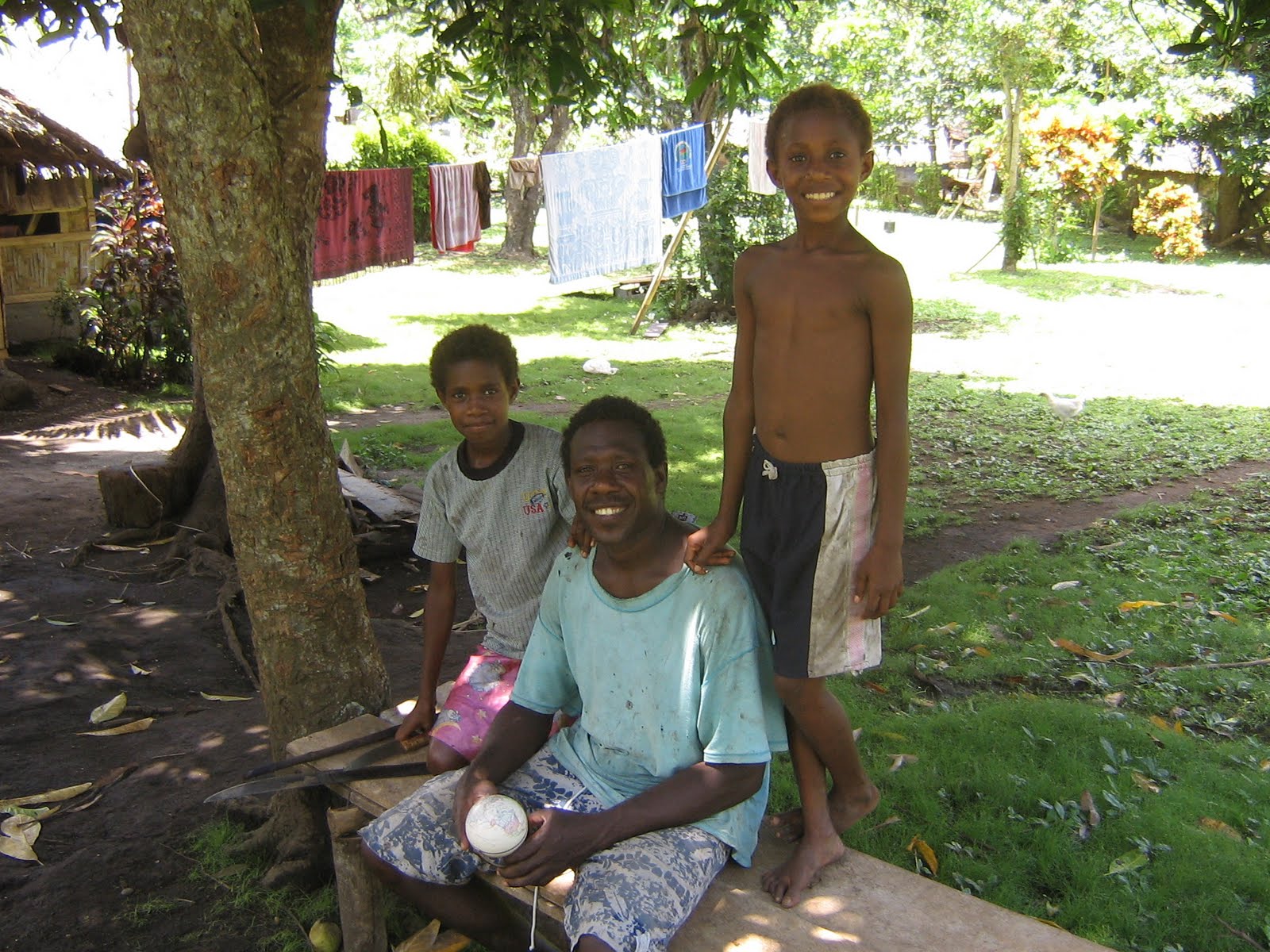
Here is my host papa Daniel with his two daughters Melanie and Josephine under the obligatory mango tree next to my house. We've been looking over my little world globe. This little area between my house, my parent's house, and Robinson and Seesie's house is like our living room. There are a few benches and when not planting yams, or playing Rambo in the jungle, this is where you'll find my family.

Melanie will be starting seventh grade this week and Josephine will be starting grade six. Both were are the top of their classes in December.


On the other side of the little clearing is Robinson and Seesie's kitchen (on the right). Papa Robinson, posed here, is an agricultural officer for Shefa Province and somehow part of our family. He's one of the more educated people in Alak and his Bislama is peppered with words like "how" instead of "olsem wannem" and "bench" instead of "ples wea yumi save sidaon".


Like most of the women, Mama Seesie never seems to stop working. Once everyone is fed, the garden is taken care of, the kids of allright, the church is clean, and the cows have been moved to new grass, it's mat making time.


Papa Robinson on the left and Morris on the right. This is one of the few times Morris is wearing a shirt so it must be Saturday morning before church. Sometimes called "Morris Australia", he wasn't able to attend school as a child due to what I think was a heart condition that required a lengthy stay in Australia for medical attention. He's continually amazed when I work in the garden, prepare manioc, or clean a fish.


More mat making in front of Seesie and Robinson's house.

Thanks for visiting and I'll try to post more pictures when I can

Sunday, February 6, 2011

Photos from Epi

I've managed to load some photos. I'll try to organize them and add captions tomorrow.

Good night,

Daniel


Photos from Epi: Captions

Good Morning,

It's 7:30am on Super Bowl Monday here in Port Vila. There was a burst of sudden internet connectivity last night that allowed me to post so many pictures, but it appears to have left me. So, there won't be any new pictures this morning, but I can explain the others. There's a way to add these captions to the original post directly, but its all but impossible without the page timing out. Frankly, I'm thinking it a small miracle that I can post anything. Years of working with a computer doesn't do one much good in Vanuatu.

If you'd like to make some sense of yesterday's pictures, I recommend opening that post in a separate window. Here are the captions.

1: In mid-November, on my second week on Epi, I took a little "business trip" around the island. Robinson (yellow shirt on my left), a local Agriculture Officer, Marco (green shirt on Robinson's left, one of the 4 area secretaries on Epi, and Michael (taking the picture), a Shefa livestock officer from Vila, were set to tour about ten villages on Epi describing a promoting the upcoming Livestock Day on Efate. Michael was trying to get villages to send small livestock to Port Vila to sell there. Well, I found out about the trip the morning they were set to leave and weaseled my onto the truck with them. We traveled for four days, sleeping in the villages and making stops along the way where Michael and Robinson would tout Livestock Day. After they gave their speech, they would introduce me and I would give my twenty minute talk-talk about why I'm on Epi and how I would like to work with them. By the time we had reached far off Ngala, we had our traveling sales pitch pretty worked out and I was rattling off Bislama the whole way.

One of the last villages we visited was Moriu, home to Laura, a volunteer starting her third year in Vanuatu. She's the white face to my right. Her host papa is standing on the right in the white shirt. The large thatched building is the village nakamal, were everyone was summoned for the meeting. There's one in every village and they serve as city hall, court house, all around meeting place, and during la-fetes, good places for the men to gather and butcher cows.

2: Looking out of the nakamal at Moriu, you can see there new tam-tam. A tam-tam is a tree carved into a statue/drum. Notice the slit down the middle. When it's time for a meeting, the locals hit the sides with a stick to summon everyone. Radio Vanuatu plays the sound of tam-tams before making announcements.

3: Marco inside the nakamal. Marco is one of the four area secretaries I work with. Since we were traveling through his area on Epi, he was in charge of us and arranged things with the villages. Marco lives in nearby Malvasi, so I see him regularly. I've gotten to rely on him for explanations about what the heck is happening around me.

4: Me and Michael, the visiting livestock officer, having breakfast in Nikaura. It's not morning in Epi unless there's boiled bananas.

5: The view from Nikaura. That's Ambrym in the far distance. The night before, the Ambrym volcano had been active, and you could see the red beacon from the shore.

6: Lopevi, a small island visible from Northen Epi. The story is that after the volcano became active again, the people of Lopevi came to Epi and are now in Ngala village. There's is reportedly one old man still living on the island who just didn't want to leave home and comes to Epi regularly in his canoe to grow food that can't be grown there. This is one of many non-verifiable stories that may or may not be true, but I actually believe this one if for no other reason than that the people of Laman island do make the two hour canoe ride to Epi regularly to tend to gardens they have on Epi and then row back with a canoe full of bananas.

7: Another tam-tam at another nakamal. The swirl in the forehead is probably representative of the round pig tusks that are one of the main symbols of vanuatu. The round tusk is present on the flag, the money, and on the labels of Tusker brand beer.

8: I'm following Michael, Marco, and Robinson. We took a truck from one village to where the road ended, then walked along this remarkable beach for about half a mile so we could get into a small speed boat at the end that took us across the bay to Ngala. All so that we could have yet another meeting about livestock and why on Earth I'm volunteering in Epi.

9: Michael is a kava fan and wanted me to take a picture of him pounding kava root before steeping, squeezing, and drinking the stuff. This is the main method for making kava on Epi, unlike Efate where they use a mince meat grinder, or on Tana where you chew it and then have a virgin boy squeeze it for you. A volunteer on Tana explained to me that since women are *ahem* unclean, they may not touch a man's food after cooking it and may not squeeze kava. Men who touch women are just as unclean so only virgin boys can squeeze the kava. Epi has no such rules as far as I can tell.

10: Papa Robinson and Mama Seesie's house. Yes, that's a motorcycle, but no, it doesn't work. Seesie and Robinson are my neighbors and essentially part of the family. Like my host family, they are part of the Seventh Day Adventist church and live on our little SDA third of the village.

11: Another view of Robinson's house. This is a slightly patriachal society, though not consciously so. People will instinctively tell you that this is Robinson's house and refer to Robinson's family, but if I were to call it Mama Seesie's house, no one would think twice about that.

That little shelter in the middle is where they keep and wash their dishes and the kitchen house is on the left.

12: Spot or Spotty, our dog whom Papa Daniel insists is lazy because he sometimes doesn't follow the family to the bush.

13: Robinson's house again. Papa Daniel built this house and as a testament to his craftsmanship notice the thatched overhand and, wonder of wonders, this house is L-shaped!

14: My house! My papa built this house with the help of one other man and it's a mansion. Look at that cement foundation and that natangura (thatch) roof.

15: Another view of my house. I can close up those windows in the forground, but not the ones in the back. Yes, there's a wooden door and it has a lock. The family just put the calico there for decoration I think.

16: This is the shelter by my grandma's kitchen where we sometimes gather for meals. Pumkins and snake beans grown on top. The building in the back on the right is grandma's (Apu's) kitchen.

17: That's my swim house where I take my twice daily bucket baths. Have you noticed yet that there's a separate building for everything? A family may have one or two main houses for sleeping and generally living, a swim house, a smol haos (toilet), a kitchen, and maybe a wash house or a tool shed. There are also little shelters about and benches since we spend most of our time outside anyway.

18: Apu blong mi (right) and Mama blong mi (left) are using split sticks to place hot stones on top of lap-lap leaves. Lap-lap leaves are like banana leaves and are used when you make, you guessed it, lap-lap, the traditional dish of Vanuatu. The mashed banana, manioc, taro, kumala, or yam is wrapped between two layers of leaves and those stones are going to cook it for several hours.

19: Anthony and me in Natakoma, my training village on Efate. I vaguely remember a time when I lived in a house with walls and ceiling like that.

20: My host family in Natakoma are inspecting my little globe. Papa Thomas is showing where you can find Vanuatu.

That's what I can offer for now. There will hopefully be more to come when I'm able.


Daniel

Saturday, February 5, 2011

Returned from the Bush

Good Morning,

It's eight o'clock, Sunday morning, February 6, 2011. After about three months on the island of Epi, I've been summoned back to Port Villa for two weeks of additional training and other administrative bruhaha. There is intermittent internet access so I am going to try posting photos and responding to comments today.

I am doing well, though, as has been the case every time that I've come to the capital, plagued by a long list of things to do and not given enough time to do them. It's become apparent that many of those catchy slogans the Peace Corps slaps onto brochures and posters are quite true, especially the one saying it's "The toughest job you'll ever love". I'll be in touch and will try to post a lot of pictures before going back to my island.


Daniel

Saturday, November 6, 2010

Training is Finished!

Sunday, November 7, 2010,

Our eight weeks of training is over and I am now a Peace Corps volunteer. Let's begin and the beginning. My group of 41 trainees left Los Angeles on September 10 and arrived in Port Villa, Vanuatu on September 12, having missed the 11th when flying over the international dateline. After a warm (literally) welcome, we were shuffled off to a IDS camp in the nearby town of Pango on the edge of Port Villa. There, we lived barracks style for a week while attending the first of what would become many classes, workshops, and training sessions. That's also when my metabolism started to kick in to high gear, but more on that latter.

After a week at the IDS camp facilities, Group 23, as we're called, was sent to training villages in North Efate. The five villages were about as far from Port Villa as you can get while staying on the same island. They included the well established Paunangisu and Epau as well as the small and seemingly more distant Ekipe as well as Takara A and my village, the smaller, newer encampment of Takara B. Only 5 of our group of 41 were sent to Takara B and we had a great time of it. Under the tutelage of George, our language instructor from Ambae, and with the help of my host parents Thomas and Fatima, I was able to learn a good deal about the culture and custom of Vanuatu as well as pick up a significant amount of Bislama.

The stories we five have from Takara B could fill a few pages by themselves. Just a few worth mentioning include the time when we became surprise guests of honor at the opening of the new road-side market and the official renaming of the village to Natakoma Komuniti. After repeated suggestions from the villagers, we took a small boat over to the nearby island of Emau, where the residents of the Takaras hail from originally. Then there was the time Andrew, my Mama, Chief Sam, and I climbed nearby Quinn Hill overlooking the whole area so that we could view the remnants of the old US military installation on top. It was an excellent place to put a “bigfalla musket” to shoot at approaching ships, as we learned from the chief. Of course, Andrew and I were referred to by the kustom names we had received on our second week in the village. He is Caul Fal (New Man) while I'm Tai Wia (Good Brother).

In between lessons and on the weekends, we tried to learn as much as we could from the villagers. I think I have a handle of taro and yam growing and look forward to making my own garden at my new site. Cleaning clothes with a basin of soapy water, a board, and a stiff brush is a time consuming task that I'll just have to get used to. I've drank enough kava now to know I should avoid it and I think I have good handle on how it's made.

The kava bars in the village cut the root and grind it in a mince meet grinder before adding the water and squeezing it, while the folks on Tanna used a noticeably different approach. At about week 5, all the trainees were sent on host-volunteer visits on different islands where we could see how a current volunteer lived and worked. I was set to go to Tanna with one other business volunteer, but he was medically separated just before so it was just me with Arthur in Middle Bush, Tanna followed by a day with Marion in Lenekel, Tanna. In addition to kustom dancing until dawn, roasting coffee in a metal drum, collected and eating wild pumkin, chasing horses in a truck, bathing in a waterfall, inspecting water pumps, chewing on whole vanilla beans, and eating, eating, eating, I was treated to some homebrew kava, Tanna style. First, the adult men (far away from the women who are forbidden from participating) chew the peeled kava root for a long time and spit the softened mush onto banana leaves. Next you have to get a boy. On Tanna, the men are forbidden from squeezing coconut shavings or kava so a boy must do it for you. The watered, squeezed kava juice was enough to fill four small bowls. We didn't have actual coconut shells this time. That stuff really makes the evening cicadas seem like a racket.

Back in Natakoma, we prepared to go to our new sites and say our goodbyes to our host village. The last night in the village got more emotional than we were prepared for. The village mamas had prepared a big “lask kakae” feast for everyone. Speeches were made and gifts given and the slightly formal manner of the islands. My fellow trainees more or less “volunteered” me to make a little speech on our behalf and then the hand shakes, hugs, and crying began.

The next morning we were off to Port Villa where I am now, preparing to go to site. 39 of us will be heading out, having lost one more person who I am led to believe quit for here own reasons. Swearing in last Thursday, was a great even from what I've been told. I was there, sworn in, and am now a fully fledged volunteer, but I was so sick that I wasn't really concentrating much on the speeches and presentations. Bit of a shame to, as I was supposed to give the big Bislama speech on behalf of our class, but was unable to. I'm glad I got to attend. I'm fine now. It was just another weird bug in a long list of ailments I've had here. They come and go fast.

So, here's the big news. On Wednesday, I'm going to the island of Epi. I will be living in a thatched roof house in the village of Alek near Rovo Bay. My job is to work with a few counterparts in the Shefa Provincial council to conduct community surveys and assessments on the island as well as help build the business capacity of the people in the area as well as the council itself. Yes, it's a bit vague, but most of the positions are. I'm a frontier capitalist riding through the territories with a fistful of ideas, squaring off with any and all comers who want help.

For those wondering about creature comforts: I will be growing a garden, but buying localing grown food until that comes in. There is no electricity in my village, but there usually is in Lamon Bay, a one and a half hour walk North. There is a potable water tap close to my little house. My host parents, whom I believe are in their thirties live nearby. My “smol haos” is seperate and bucket showers will continue to be the norm. I bough a small gas stove for about 9,000 Vatu ($90) and will be cooking with gas when I don't want to collect firewood. Lastly, I guess I'll be eating a lot of the local peanuts and pumpkins.

More to Come.


- Daniel